
Fighting for Child Custody in India? Read This First
When a marriage breaks down, property disputes and legal notices can wait.
However, one question immediately takes over every parent’s mind:
“What will happen to my child?”
In India, child custody battles are emotionally exhausting, legally complex, and often clouded by myths. Many parents walk into court believing that mothers always get custody or that fathers are limited to weekend visits. Fortunately, Indian family law has evolved far beyond these outdated assumptions.
Let’s clearly understand how child custody laws in India actually work, what courts truly care about, and how you can protect your child’s future during this difficult phase.
The One Principle That Decides Every Custody Case in India
First and foremost, Indian courts follow one unbreakable rule:
The welfare of the child comes above everything else.
Courts do not decide custody based on:
- Who earns more
- Who filed for divorce
- Who was “right” or “wrong” in the marriage
Instead, under Section 26 of the Hindu Marriage Act, the Guardians and Wards Act, 1890, and multiple Supreme Court judgments, judges consistently focus on:
- The child’s emotional well-being
- Physical safety
- Education and stability
- Mental and psychological health
In short, courts ask:
“Where will this child grow up happier, safer, and more secure?”
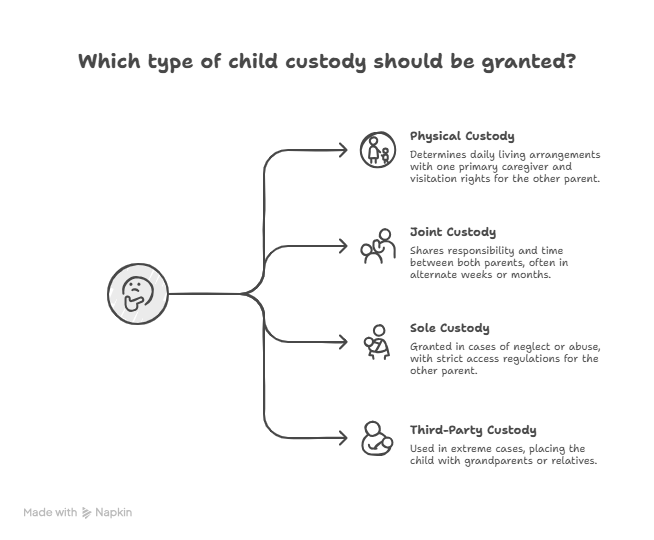
Types of Child Custody in India
1. Physical Custody
This determines where the child lives daily. One parent becomes the primary caregiver, while the other receives visitation rights.
2. Joint Custody
Here, both parents share responsibility and time.
For example:
Alternate weeks
6 months with each parent
Although still rare, courts in metropolitan cities increasingly support joint custody when both parents cooperate.
3. Sole Custody
In serious situations involving neglect, abuse, or instability, courts may grant custody to only one parent, while strictly regulating the other parent’s access.
4. Third-Party Custody
In extreme cases such as alcoholism, violence, or severe mental illness, courts may place the child with grandparents or close relatives.
Do Mothers Automatically Get Custody in India?
Contrary to popular belief, the answer is no.
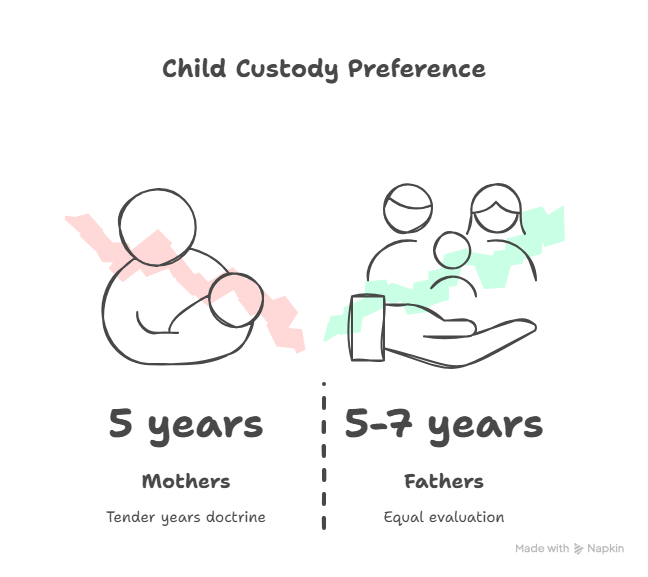
Yes, courts often apply the “tender years doctrine”, which generally favours mothers for children below 5 years. This preference exists because young children usually need constant maternal care.
However, this is not a rule—it is only a presumption.
Once a child is around 5–7 years or older, courts actively evaluate both parents equally. Fathers increasingly receive custody when they demonstrate better emotional involvement, stability, and caregiving ability.
Recent Judicial Trends
Supreme Court (2024): Custody of a 12-year-old boy awarded to the father after the court found the mother was emotionally manipulating the child against him (parental alienation).
Bombay High Court (2025): Granted 50–50 joint custody of twins, setting a clear time-sharing schedule.
Clearly, Indian courts no longer function on gender bias.
Visitation Rights: What If You Don’t Get Custody?
Even if you are not the custodial parent, your rights do not disappear.
In fact, courts usually grant:
Weekend visitation
Half of school vacations
Daily video or phone calls
Attendance at school events and medical appointments
Overnight stays during festivals
Moreover, if the custodial parent blocks or manipulates visitation, you can:
File a contempt of court petition
Seek modification or even reversal of custody
What Indian Courts Actually Examine Before Deciding Custody
Before reaching a decision, judges carefully evaluate several real-life factors:
The child’s preference (usually if above 9–10 years)
Emotional bonding with each parent
Stability of home environment
Past caregiving role
Work schedules and availability
History of domestic violence or substance abuse
Educational continuity
Sibling relationships (courts avoid separating siblings)
In other words, courts reward consistent parenting, not courtroom drama.
How and Where to File for Child Custody in India
You can initiate custody proceedings through:
Family Court
District Court under the Guardians and Wards Act
High Court (in urgent or exceptional cases)
Importantly:
There is no court fee for custody matters
Free legal aid is available for eligible parents
However, proper documentation and legal strategy make a significant difference.
A Real Custody Case from 2025
In a recent Bangalore Family Court case, the court awarded permanent custody of an 8-year-old girl to her father, an IT professional.
The mother had moved to Canada and wanted to relocate the child abroad. The court refused, observing that:
“Uprooting the child from her school, social circle, and grandparents for the mother’s career does not serve the child’s welfare.”
This case clearly shows how stability and continuity outweigh parental convenience.
A Message to Every Separated Parent
Ultimately, custody battles are not about winning against your spouse.
They are about:
Showing up for school meetings
Remembering doctor appointments
Providing emotional safety
Respecting the child’s bond with the other parent
Courts consistently favour parents who act maturely, calmly, and child-first.
Your child does not need a perfect parent.
Your child needs parents who behave like adults.
How Jaitra Associates Can Help You
If you are facing a child custody dispute, you do not have to navigate this alone.
Jaitra Associates provides compassionate, strategic legal guidance in:
Child custody and visitation matters
Divorce and family disputes
Guardianship cases
Custody modification and enforcement
We focus not just on legal success, but on protecting your child’s future and emotional well-being.