
How to Escape Domestic Violence in India Safely and Legally?
You are not overreacting.
You are not imagining things.
And most importantly, you are not alone.
Every few minutes, a woman in India faces cruelty inside her own home. If you are reading this quietly, hiding your phone, wearing sunglasses indoors, or crying silently in the bathroom, this guide is for you. Keep reading, because there is hope, there is help, and there is a safe legal way out.
What Legally Counts as Domestic Violence in India in 2025?
Most people still believe domestic violence only means broken bones or visible injuries. However, Indian law clearly disagrees.
Under the Protection of Women from Domestic Violence Act, 2005 (PWDVA)—still the strongest legal shield for women in 2025—the law recognises physical, emotional, sexual, verbal, and economic abuse.
This means domestic violence includes:
Slapping, kicking, burning, choking, or pushing
Constant insults, humiliation, name-calling, or shaming in front of children
Forced sexual relations despite refusal (covered under PWDVA even today)
Withholding money for food, medicines, rent, or school fees
Threats to throw you out of the house or take away your children
Stalking, monitoring calls, or showing up after separation
Destroying personal property or harming pets to create fear
Importantly, even one incident is legally sufficient to file a domestic violence case.
Why 2025 Is Different: The Law Finally Moves Fast
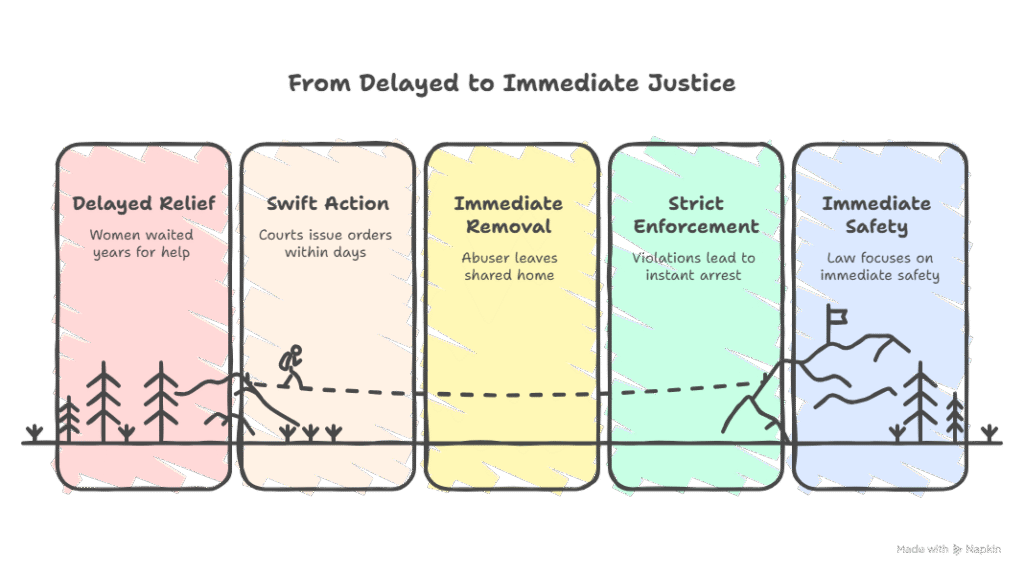
Earlier, women waited years for relief. Today, courts act swiftly.
In 2025:
Courts issue emergency protection orders within 3–7 days, sometimes the same day
Judges can order the abuser to leave the shared home immediately, even if the house is in his name
Violating court orders leads to instant arrest and non-bailable offences
Courts charge zero court fees for domestic violence cases
As a result, the law now focuses on immediate safety, not delayed justice.
5 Powerful Legal Remedies You Can Demand Right Now
1. Protection Order
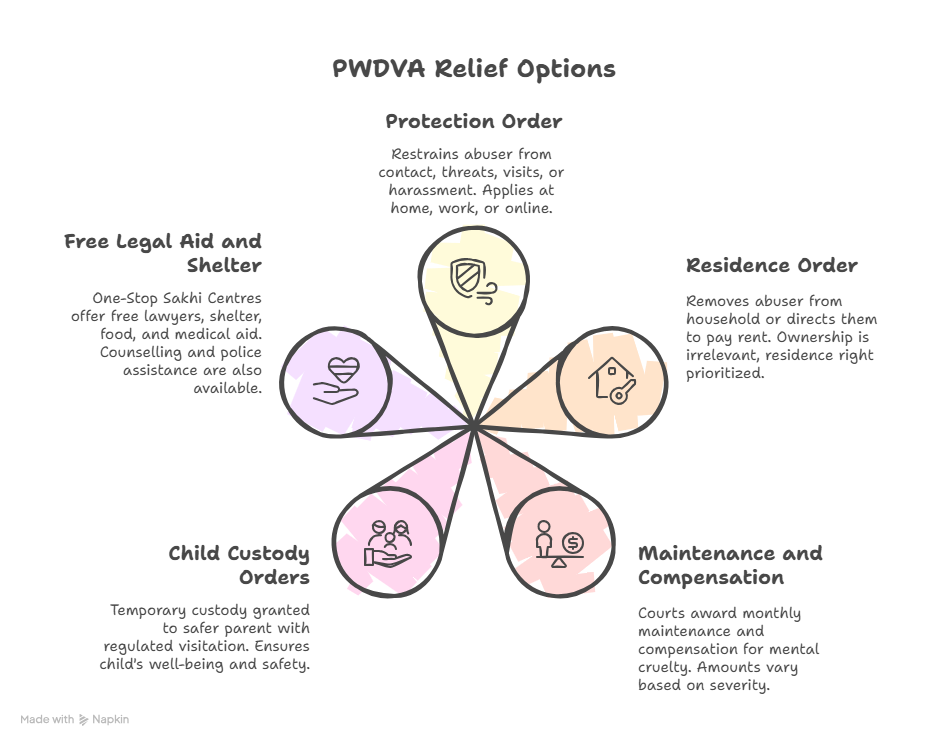
The court legally restrains the abuser from contacting, threatening, visiting, or harassing you at home, work, or online.
2. Residence Order (Most Powerful Remedy)
The court can:
- Remove him from the shared household, or
- Direct him to pay rent for a safe alternative house
Ownership does not matter. Your right to residence comes first.
3. Maintenance and Compensation
Courts across India now award:
- ₹10,000–₹50,000 monthly maintenance, and
- ₹3–15 lakh compensation for mental cruelty and trauma
4. Child Custody Orders
Courts grant temporary custody to the safer parent while ensuring regulated visitation.
5. Free Legal Aid and Shelter
Every district has One-Stop Sakhi Centres providing:
- Free lawyers
- Shelter and food
- Medical aid
- Counselling and police assistance
Real 2025 Court Decisions That Restore Faith
Delhi High Court awarded ₹12 lakh compensation and ₹25,000 monthly maintenance for prolonged emotional abuse
Supreme Court of India jailed a man for violating a protection order by sending threatening messages
Kerala High Court declared that a woman’s right to residence in her matrimonial home is a fundamental right, regardless of ownership
These judgments prove that courts now act decisively and firmly.
How to Leave Safely Without Putting Yourself at Risk
Leaving an abusive environment is the most dangerous stage. Studies show nearly 75% of domestic violence deaths occur during separation. Therefore, plan carefully.
Prepare a hidden “go-bag” with ID proofs, certificates, cash, medicines, and an extra phone
Save money discreetly or trust a reliable friend
Memorise one safe address
Teach children to call 1098 during emergencies
Create a code word with a trusted person for immediate help
Preparation saves lives.
How to File a Domestic Violence Case in India (Step-by-Step – 2025)
Step 1: Reach Out for Immediate Help
You can call or WhatsApp any of these 24×7 numbers:
Women Helpline: 181
Police Emergency: 100
Women in Distress: 1091
National Commission for Women: 7827170170
Step 2: Preserve Evidence Quietly
Collect evidence without alerting the abuser:
Photos of injuries (with dates)
Audio recordings of threats
Screenshots of abusive messages
Medical records (even from local clinics)
Step 3: Contact Any One Authority (Free)
You may approach:
The Protection Officer
A registered NGO or Service Provider
The Magistrate Court directly
Step 4: File the Domestic Incident Report (DIR)
One simple form officially activates legal protection.
Step 5: Attend the First Hearing
Courts usually conduct the first hearing within 3 days and aim to complete proceedings within 60 days.
A Message to Every Woman Still Trapped
You are not weak.
You are not a burden.
And you are not destroying your family.
You are choosing survival, dignity, and peace.
The law supports you.
The courts believe you.
And thousands of women rebuild their lives every single day.
Need Immediate Legal Help?
If you are facing domestic violence, you do not have to navigate this alone.
Jaitra Associates provides compassionate, strategic legal guidance.
Take one deep breath.
Then take the first step.
Because the rest of your life can be peaceful, joyful, and completely yours.